
Almost every business that serves people has a wait in it: the table, the chair, the repair, the wash cycle, the pickup counter. Customers tend to forget the product and remember the wait, and the research on queues backs this up in a general way: an occupied wait feels shorter than an empty one, and an uncertain wait feels longer than a known one. That gives you three things to work on, in order.
Step one: shorten or explain the wait
Before you spend anything on entertainment, look at the wait itself. Distraction is the last resort, not the first, and an entertained customer who has been lied to about timing is still an angry customer.
- Quote honestly. A wait of thirty minutes that is described as thirty minutes is easier to bear than a wait of twenty that was described as ten.
- Tell people what is happening. A text when the car is ready, a buzzer for the table, a board with the queue on it. Uncertainty is what makes a wait feel long.
- Give people the option to leave. If you can text them when it is their turn, a good share of them will go and do something else, which frees up your waiting room.
Step two: make the waiting area comfortable
The cheapest improvements are the least exciting ones, and they work for almost every customer:
- Real seating, in enough quantity, not facing a wall.
- Water, and coffee if the wait is long. It is a small cost and it is read as hospitality.
- Working Wi-Fi with a password on a sign. Adults will entertain themselves if you let them.
- A place to charge a phone. This is more valued than most owners expect.
- Clean, well-lit space. A clean waiting room says the same about the rest of the business.
Step three: give people something to do
Once the wait is honest and the room is comfortable, distraction does its job. These are the usual options, with the real limits of each:
A television
Cheap and universal, and it works for adults. It does very little for children, and what is on the screen is a decision that annoys somebody. Muted, with captions, is a reasonable default.
Magazines and reading material
Mostly decoration now. Most people have a phone, and a pile of old magazines can make a room look neglected rather than welcoming.
A kids’ corner
Books, blocks, a small table. It is effective with younger children and costs little, but it takes up floor space, it needs to be kept clean, and it stops working at around age seven or eight, when children want something with a goal.
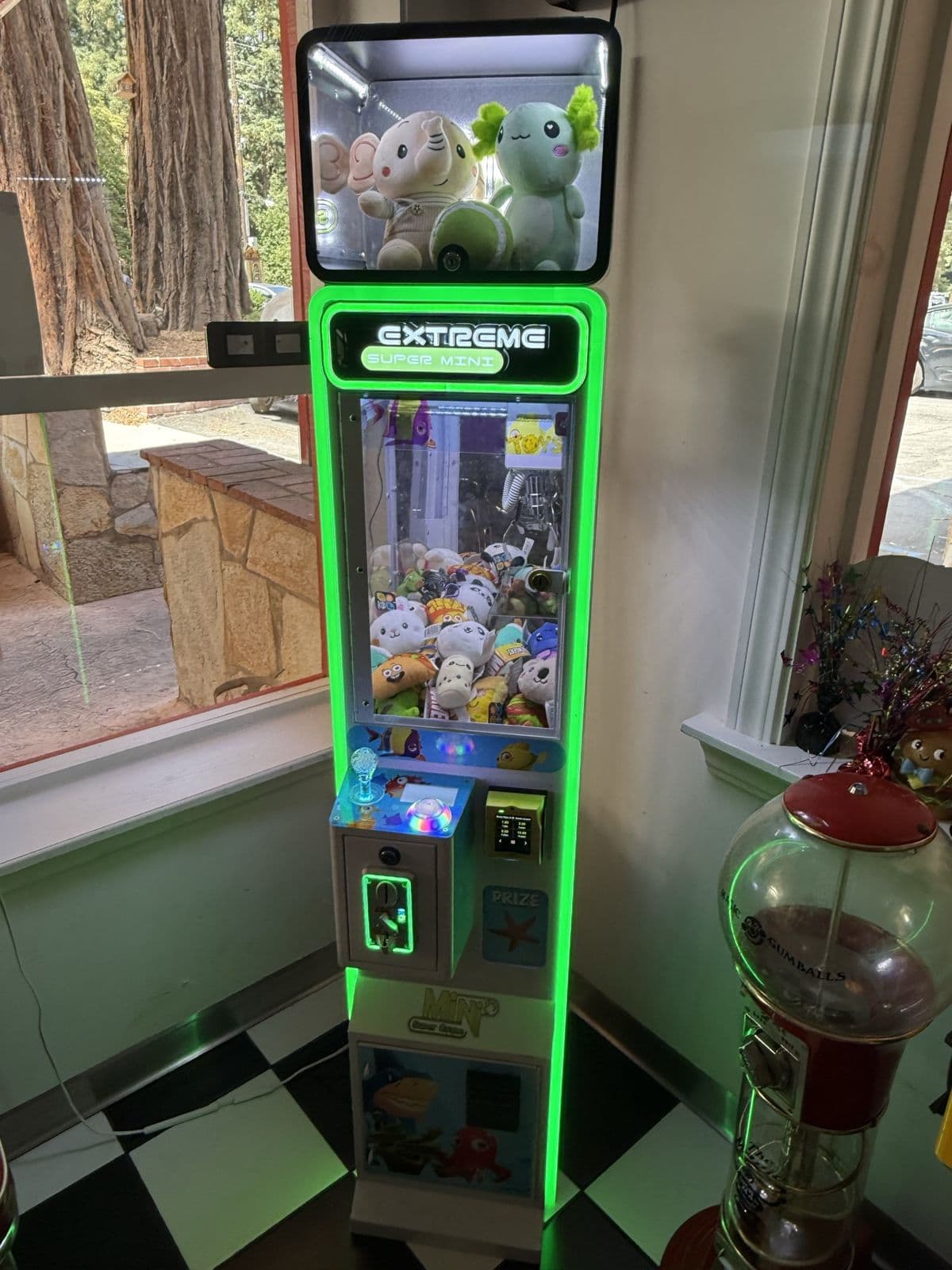
A claw machine
It has a goal, a result, and a prize, which is what children past the toddler stage want. Adults play too, and watching someone else play is a mild entertainment in itself. The honest limits: it needs about three by three feet and an outlet, it is noisy unless you turn it down, and it only earns its place where a wait is long enough, and families come often enough, to use it. We own it, service it, and restock it, so it costs the business nothing to try.
A big arcade or game room
Only if entertainment is the business. For everyone else it is too much space, too much noise, and too much management.
Where a claw machine fits best
Three conditions make it worth considering:
- The wait is between about ten minutes and an hour and a half. Shorter and nobody has time. Much longer and you need seating and food more than a game.
- Families with children are regular customers, not occasional ones.
- The room can tolerate some noise and a small crowd of children. A laundromat or an auto shop qualifies. A fine dining room does not.
Where it does not
If nobody waits, the machine has no purpose. If your complaints are about slow service, the machine is a distraction from a problem you need to fix. And if your brand depends on a quiet, upscale feel, it is the wrong object for the room. We would rather say so than place a machine that does not work for you.
A simple way to decide
Count how many families with children walk through on your busiest day, and how long they stay. If the answer is "a lot, for a while," and you have a spare three feet of floor and an outlet, a machine is worth trying. If the answer is "few, briefly," spend the effort on seating and Wi-Fi instead.
Run a business in the San Francisco Bay Area or San Diego where people wait? Tell us about your space and we will tell you honestly whether a machine would help.
Request a free machine